The 60-Second "Metabolic Reset": How to Lower Blood Sugar Without a Gym Membership
What is a Microworkout? The Science of "Exercise Snacking"
🚨 No Time for the Gym? Can You Spare 60 Seconds to Save Your Heart?
You wake up early. Your calendar is packed. Meetings, calls, deadlines—back to back. Somewhere between all that, your health quietly slips down the priority list.
You tell yourself: “I’ll start exercising when things slow down.”
But here’s the truth—they never do. And that is exactly why your heart is at risk.
The biggest hidden danger in modern India isn't a lack of marathon training; it's prolonged stillness. Fortunately, the solution doesn't require an hour at the gym. It requires the Microworkout.
1. What is a Microworkout? (The "Exercise Snack")
A microworkout is exactly what it sounds like—short bursts of activity lasting 20 seconds to 3 minutes, repeated throughout your day. Instead of waiting for a 30-minute gym session that never happens, you “snack” on movement, keeping your metabolism active from 9 to 5.
- No gym.
- No equipment.
- No excuses.
The Big Myth We’ve Been Sold
For decades, we were told: “Exercise only counts if you do 30–60 minutes in the gym.” New research from 2025–2026 has completely debunked this. When it comes to preventing diabetes and heart disease, the frequency of movement matters more than the duration.
2. The Science: Why "Movement Snacks" Work
Sitting is the new smoking. When you sit for long hours, your muscles enter a "standby mode." Your body stops handling sugar efficiently, leading to insulin resistance—the root cause of Type 2 Diabetes and heart disease.
Microworkouts flip two biological switches instantly:
A. The "Glucose Sponge" Effect
A quick set of squats activates your largest muscles (glutes and quads). These muscles act like a sponge, soaking up excess sugar from your blood without needing extra insulin.
B. The GLUT4 Switch
GLUT4 is a protein that acts as a "gatekeeper" for your cells.
- The Problem: In a sedentary body, these gates are locked. Sugar stays in the blood.
- The 60-Second Solution: Muscle contraction during a microworkout flips the GLUT4 switch "ON," pulling sugar out of your bloodstream even if you are insulin-resistant.
3. The 2026 Breakthrough: Consistency Over Intensity
Recent studies now show a striking reality: Breaking sitting every 30–45 minutes with just 2 minutes of movement is more effective at controlling blood sugar than a single 30-minute workout later in the day.
Your body doesn't want a "weekend warrior" approach; it wants consistent metabolic reminders.
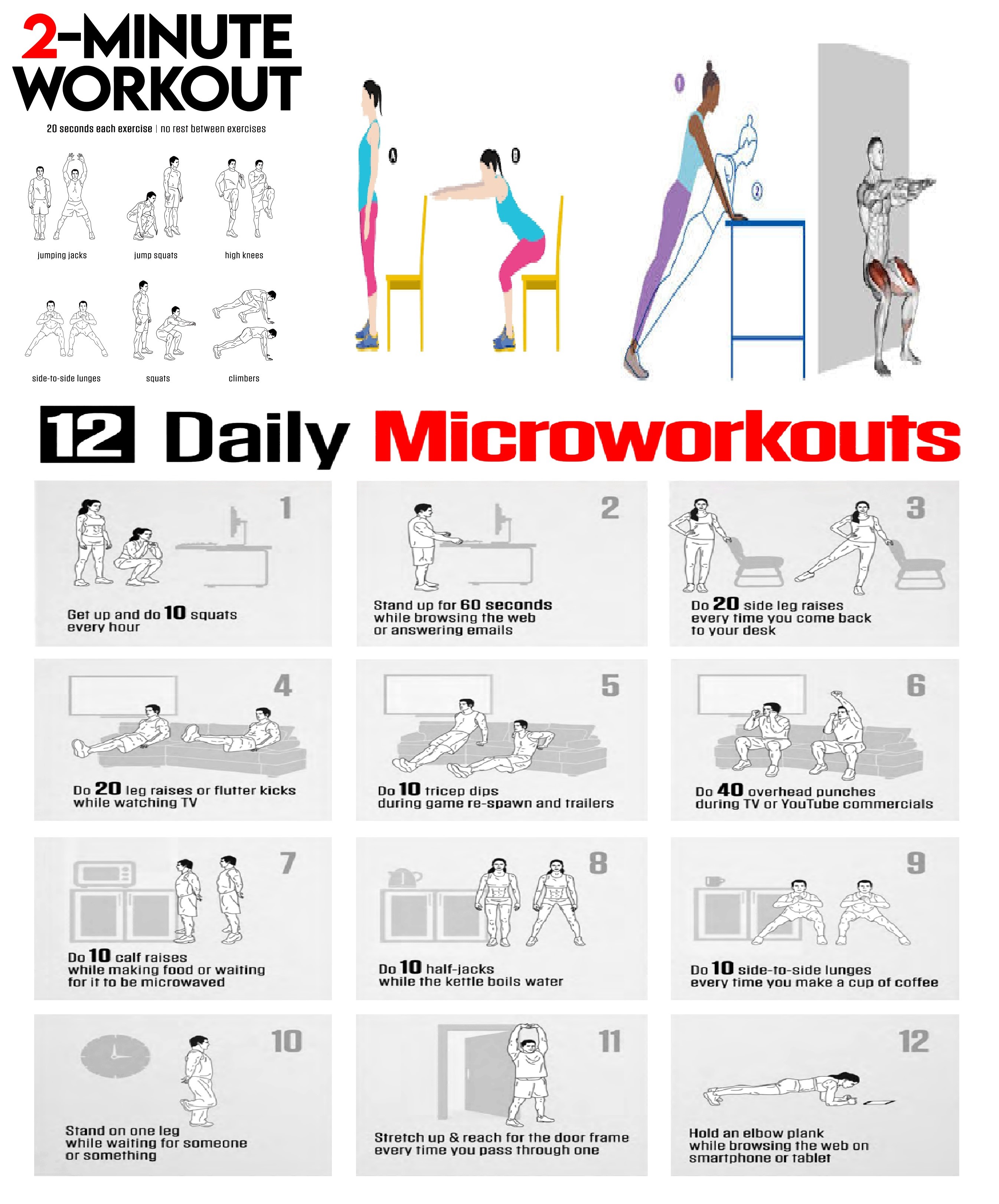
4. Your 60-Second “Workout Menu”
You don’t need to change clothes or block time. Just plug these into your day:
| The "Snack" | Duration | Why It Works |
| 🪜 Stair Sprint | 30–60 Sec | Boosts heart fitness and VO2 Max instantly. |
| 🪑 Chair Squats | 15–20 Reps | Activates the body’s biggest "glucose sponges." |
| 💪 Desk Push-ups | 10–15 Reps | Engages the core and fixes "desk posture." |
| 🧱 Wall Sit | 45 Seconds | Lowers blood pressure through isometric tension. |
| 🚶 Pacing Calls | Duration of Call | Prevents the metabolic shutdown of sitting. |
5. The Real Secret: Habit Stacking
The problem isn’t exercise; it’s remembering to do it. Don’t “find time.” Attach movement to habits you already have:
- 🍲 The Microwave Minute: Do counter-top push-ups while waiting for your food to heat up.
- 💻 The Meeting Reset: Do 10 squats immediately after every Zoom call ends.
- 🏢 The Commuter Climb: Always take the stairs if you are going up fewer than 3 floors.
6. The Bottom Line: Your Heart is Keeping Score
In today’s high-stress, high-sitting world, the solution isn’t complicated. You don’t need perfect motivation; you need 60 seconds.
Your meetings won’t stop. Your workload won’t shrink. But your heart is keeping score of every hour you remain still. Can you really not spare 60 seconds to save your own life?
Medical Disclaimer
This content is for educational purposes only and is not a substitute for professional medical advice. Individuals with existing medical conditions or high cardiovascular risk should consult their healthcare provider before starting any new exercise routine.
ARTICLE AUTHOR
Dr. Kamales Kumar Saha
Clinician–Leader · Cardiac Surgeon· Preventive Cardiologist · IICA-Certified Independent Director, Author : The Silent Epidemic
Dr. Kamales Kumar Saha is a seasoned Clinician–Leader with boardroom judgment, combining deep expertise in cardiac surgery and preventive cardiology with strategic healthcare leadership. His work bridges clinical excellence and patient education— helping patients make informed, sustainable health decisions.
Copyright Notice
© 2026 Dr Kamales Kumar Saha. All rights reserved.
No part of this blog may be reproduced, stored in a retrieval system, or transmitted in any form or by any means: electronic, mechanical, photocopying, recording, or otherwise without the prior written permission of the author, except for brief quotations used in reviews or scholarly references. This book is intended for personal reading only and may not be redistributed, resold, or reproduced in any format without permission.