His TMT Was Normal. He Still Had a Heart Attack.
The Dangerous False Reassurance of a Normal Treadmill Stress Test
By Dr. Kamales Kumar Saha, MBBS, MS, DNB, MCh (AIIMS), MD (USA)
Senior Consultant Cardiac Surgeon & Preventive Cardiologist
35+ Years Clinical Experience | 7,000+ Heart Surgeries | IICA-Certified Independent Director
The Dangerous False Reassurance of a Normal Treadmill Stress Test
A 46-year-old executive came to see me after surviving a major heart attack. He exercised regularly, maintained what he believed was a healthy lifestyle, and had undergone a treadmill stress test (TMT) only eight months earlier. The report was reassuring: Normal. Negative for inducible ischemia. Confident that his heart was healthy, he returned to work, resumed his daily routine, and stopped worrying.
Then one morning, everything changed.
He developed severe chest pain while getting ready for work. Emergency coronary angiography revealed a ruptured coronary plaque that had suddenly blocked one of his major heart arteries. His normal treadmill test had not predicted the event.
During more than three decades as a cardiac surgeon and preventive cardiologist, I have seen this story repeated far too often. The treadmill stress test was not performed incorrectly. It simply answered a different clinical question. Understanding that difference may save your life.
What a Treadmill Stress Test Actually Measures
One of the biggest misconceptions in cardiology is that a normal treadmill stress test proves your coronary arteries are free of disease. It does not.
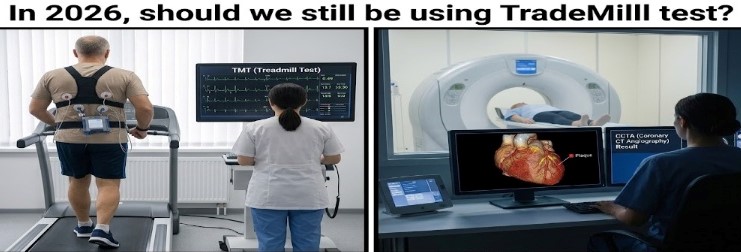
A treadmill stress test is a functional test. It looks for changes in the electrocardiogram (ECG) that occur when the heart muscle receives insufficient blood during exercise. These changes usually appear only when a coronary artery has become significantly narrowed, often by about 70% or more.
That means the test is designed to detect flow-limiting obstruction, not the early stages of atherosclerosis.
Unfortunately, many heart attacks begin long before an artery becomes severely narrowed.
Research over the past two decades has shown that many acute coronary events arise from vulnerable, cholesterol-rich plaques that produce only mild or moderate narrowing. These plaques may not reduce blood flow enough to trigger abnormalities during exercise, yet they can suddenly rupture, forming a blood clot that completely blocks the artery within minutes.
In other words, your treadmill test may appear perfectly normal while dangerous plaque continues to develop silently inside the artery wall.
That is why a normal TMT should never be interpreted as a guarantee that your heart is free of coronary artery disease.
Why Modern Cardiology Is Looking Beyond the Treadmill
The treadmill stress test was introduced decades ago, when doctors had very few non-invasive options for evaluating coronary artery disease. At the time, it represented an important advance because it allowed physicians to assess patients without immediately proceeding to invasive coronary angiography.
Medicine, however, evolves.
Today's imaging technology allows us to look directly at the coronary arteries rather than relying solely on indirect signs of reduced blood flow.
Coronary CT Angiography (CCTA) is one of the most significant advances in preventive cardiology. Instead of asking whether blood flow becomes inadequate during exercise, it shows the coronary arteries themselves.
It can identify:
- Calcified plaque
- Soft, cholesterol-rich plaque
- Early arterial wall changes
- Overall plaque burden
- The precise location and severity of narrowing
For many patients with stable chest pain, contemporary international guidelines now recommend coronary CT angiography as a preferred first-line investigation because it provides detailed anatomical information that an exercise ECG simply cannot.
This does not mean the treadmill stress test has no role. It remains useful in selected patients, including assessment of exercise capacity, exercise-induced rhythm abnormalities, cardiac rehabilitation, and situations where advanced imaging is unavailable.
The mistake is assuming that a normal TMT automatically means a healthy heart.
Nothing could be further from the truth.
Why This Matters Even More for Indians
South Asians develop coronary artery disease differently from many Western populations.
Many Indians accumulate visceral fat, develop insulin resistance, and experience metabolic inflammation years before obvious symptoms appear. Elevated Apolipoprotein B (ApoB), Lipoprotein(a), high hs-CRP, diabetes, pre-diabetes, and fatty liver disease all accelerate plaque formation.
As a result, many seemingly healthy individuals develop coronary plaque in their thirties and forties despite having few traditional warning signs.
This helps explain why heart attacks often occur in people who appear fit, attend the gym regularly, or complete an excellent treadmill test.
Physical fitness improves endurance.
It does not necessarily eliminate vulnerable plaque.
In fact, one of the most dangerous misconceptions I encounter is:
"Doctor, my TMT was normal, so I assumed everything was fine."
That sentence has preceded far too many emergency operations in my career.
The Fitness Paradox: Why Healthy-Looking People Still Have Heart Attacks
One of the most dangerous myths in preventive cardiology is that being fit automatically means having healthy coronary arteries.
It does not.
Many of my patients who required bypass surgery were professionals who exercised regularly, maintained a normal body weight, and completed demanding treadmill stress tests without difficulty.
The explanation is straightforward.
Exercise improves cardiorespiratory fitness, muscle efficiency, and endurance. It does not automatically prevent the formation of vulnerable coronary plaque, particularly in people with insulin resistance, elevated Apolipoprotein B (ApoB), Lipoprotein(a), diabetes, chronic inflammation, or a strong family history of premature heart disease.
A physically fit individual can often achieve an excellent workload during a treadmill test, producing a completely normal report despite harboring plaques that remain invisible to the test.
The danger lies not in reduced fitness but in false reassurance.
Can a Treadmill Stress Test Trigger a Heart Attack?
This question deserves a balanced answer.
For the vast majority of appropriately selected patients, treadmill stress testing is safe, with serious complications being uncommon when performed under proper medical supervision.
However, no exercise stress test is entirely risk-free.
Exercise increases heart rate, blood pressure, and the force of blood flowing through the coronary arteries. In patients with unstable or highly inflamed plaques, this physiological stress may contribute to plaque disruption or trigger dangerous heart rhythms, although such events are rare.
The greater concern is not that the treadmill causes heart attacks.
The greater concern is that a normal treadmill report may delay further evaluation in people who continue to carry significant coronary plaque.
That distinction is crucial.
A Better Strategy for Preventing Heart Attacks
Preventive cardiology has changed dramatically over the last decade.
Instead of waiting until blood flow becomes critically reduced, modern practice aims to identify disease before symptoms appear and before plaque becomes unstable.
For many people at increased metabolic or cardiovascular risk, a more comprehensive evaluation may include:
1. Coronary CT Angiography (CCTA)
For patients with symptoms, diabetes, a strong family history, elevated Lipoprotein(a), or intermediate cardiovascular risk, CCTA provides a detailed anatomical assessment of the coronary arteries.
Unlike a treadmill test, it can identify both obstructive and non-obstructive plaque, helping clinicians make more informed treatment decisions.
2. Look Beyond Cholesterol Alone
Traditional lipid testing remains important, but additional markers often provide a clearer picture of cardiovascular risk.
Depending on individual circumstances, your physician may recommend:
- Apolipoprotein B (ApoB)
- Lipoprotein(a)
- High-sensitivity C-reactive protein (hs-CRP)
- HbA1c
- Fasting insulin
- Triglyceride-to-HDL ratio
These tests help identify the metabolic drivers of plaque formation long before symptoms develop.
4. Treat the Cause, Not Just the Numbers
The objective is not merely to lower cholesterol.
The real goal is to stabilize plaque, reduce inflammation, improve insulin sensitivity, control blood pressure, optimize body weight, and prevent plaque rupture.
That is how heart attacks are prevented.
Summary Table
| Feature | Treadmill Stress Test (TMT) | Coronary CT Angiography (CCTA) |
| Primary purpose | Detects reduced blood flow during exercise | Directly visualizes coronary arteries |
| Detects soft plaque | No | Yes |
| Detects calcified plaque | No | Yes |
| Detects early coronary disease | Limited | Excellent |
| Best suited for | Functional assessment in selected patients | Anatomical assessment of coronary artery disease |
| Sensitivity for coronary artery disease | Moderate | High |
| Exercise required | Yes | No |
| Risk during test | Very low but includes exercise-related risk | Non-invasive imaging without exercise |
| Typical cost in India | ~₹3,000 | ~₹15,000 |
| Role in modern practice | Useful in selected clinical situations | Preferred first-line investigation for many patients with stable chest pain according to contemporary international guidelines |
Key Takeaways
- A normal TMT does not rule out coronary artery disease.
- Many heart attacks arise from vulnerable plaques that may not produce abnormalities during a treadmill test.
- Physical fitness does not guarantee healthy coronary arteries.
- Diabetes, pre-diabetes, obesity, insulin resistance, elevated ApoB, and Lipoprotein(a) require a more comprehensive cardiovascular assessment.
- Modern preventive cardiology focuses on identifying plaque before it causes symptoms.
Conclusion
For decades, the treadmill stress test has been an important tool in cardiology. It continues to have a role in carefully selected patients.
But medicine advances because evidence advances.
Our goal should no longer be simply identifying arteries that are already severely narrowed.
Our goal should be detecting coronary disease earlier, understanding the metabolic processes driving plaque formation, and preventing heart attacks before they occur.
As someone who has spent more than 35 years operating on diseased hearts, I believe the greatest achievement in cardiology is not performing another successful bypass operation.
It is helping a patient avoid needing one.
Unsure About Your True Heart Risk?
If you have diabetes, pre-diabetes, obesity, high cholesterol, a family history of premature heart disease, or persistent concerns despite a normal treadmill stress test, it may be time for a more comprehensive cardiovascular assessment.
At Diabetes & Obesity Clinic and HeartClinic, we focus on identifying cardiovascular risk before symptoms become life-threatening through evidence-based metabolic evaluation, advanced risk assessment, and personalized prevention strategies.
Learn More
To better understand why seemingly healthy young Indians are suffering heart attacks, and more importantly, how you can prevent one, read my eBook:
📘 Heart Attack Before 50
WHY HEALTHY YOUNG INDIANS ARE DYING
HOW YOU CAN DEFEAT IT https://play.google.com/store/books/details?id=Jmz4EQAAQBAJ
Also available in Bengali:
📗 হার্ট অ্যাটাক ৫০-এর আগেই
সুস্থ তরুণদের হঠাৎ মৃত্যুর কারণ
আপনার বাঁচার উপায় https://play.google.com/store/books/details?id=0Yz4EQAAQBA
Both editions are available exclusively as eBooks and explain the science in simple language while providing practical, evidence-based strategies to reduce your risk of heart attack.
If you would like a personalized metabolic and cardiovascular risk assessment, you are welcome to schedule an in-person or online consultation at Diabetes & Obesity Clinic or HeartClinic.
Medical Disclaimer
This content is for educational purposes only and is not a substitute for professional medical advice. Individuals with existing medical conditions or high cardiovascular risk should consult their healthcare provider before making changes to their treatment plan.
Article Author
Dr. Kamales Kumar Saha
Clinician–Leader · Cardiac Surgeon · Preventive Cardiologist · IICA-Certified Independent Director
Author: “Heart Attack Before 50”: “হার্ট অ্যাটাক ৫০-এর আগেই”
Dr. Kamales Kumar Saha combines over three decades of surgical expertise with a focused mission on preventing premature cardiovascular disease through targeted metabolic care.
Copyright Notice
© 2026 Dr. Kamales Kumar Saha. All rights reserved.
No part of this blog may be reproduced, stored, or transmitted in any form without prior written permission of the author, except for brief quotations used in reviews or scholarly references.